 |
VLink
2.1.0
A high-performance communication middleware
|
|
VLink
2.1.0
A high-performance communication middleware
|







English | 中文 · Website · Documentation
VLink is high-performance communication middleware for autonomous driving and embodied intelligence, positioned as a full-scenario alternative to ROS 2. A single type-safe API covers intra-process, shared-memory, automotive-Ethernet, and cross-machine communication. The URL selects the backend; switching may require backend-specific addressing and parameters, while the communication primitives and main application logic remain unchanged.
The current release supports 10 transport backends, 14 serialization formats, 3 communication models with 6 core primitives, plus security, recording/playback, service discovery, 10 CLI tools, and Foxglove / Rerun visualization bridges.
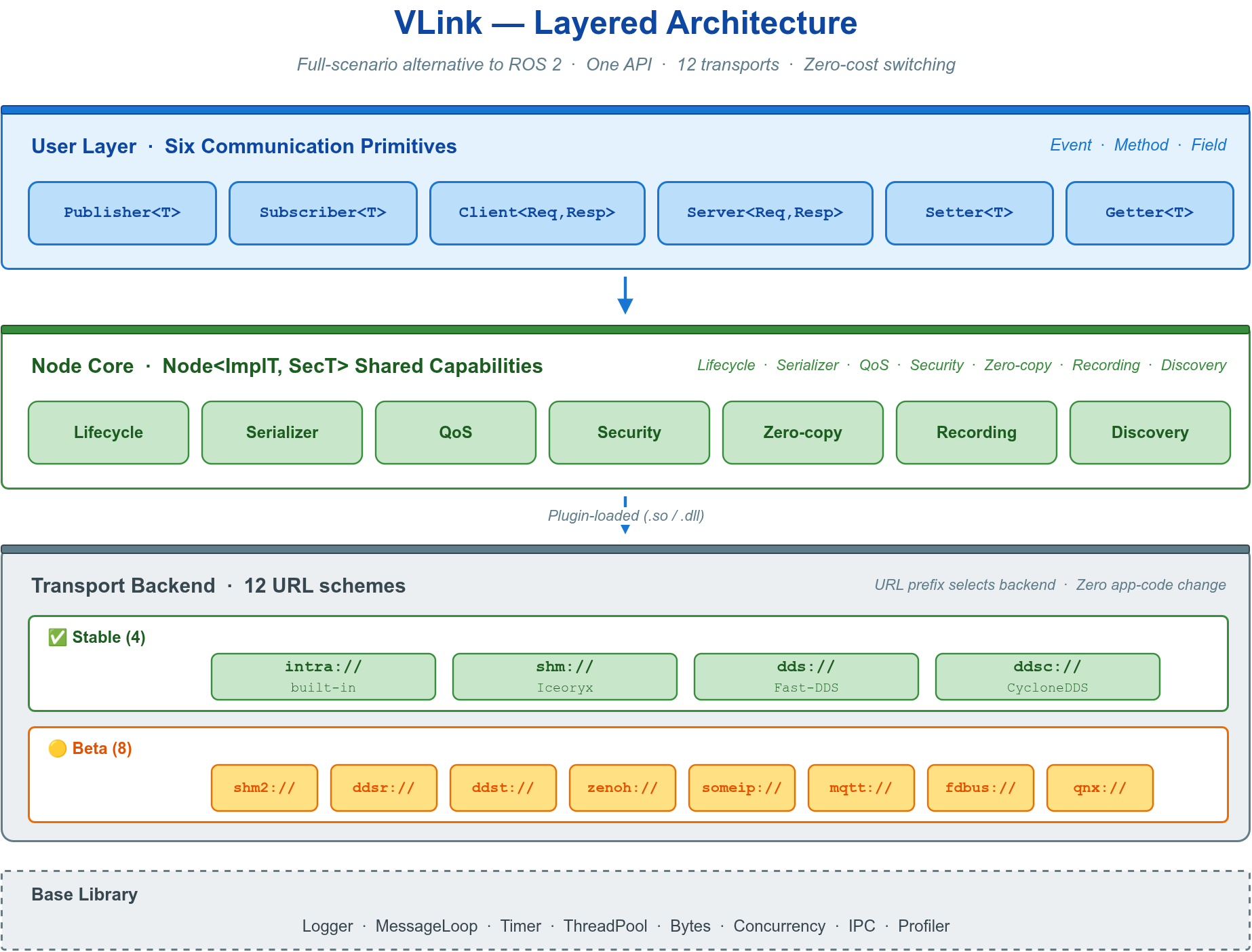
VLink's design centers on one abstraction: a communication is defined by a model, a URL, and a core method. The URL scheme selects the backend, while the complete URL carries that backend's address and parameters.
The scheme selects the backend. Topic-style backends with compatible addressing can usually be switched by changing the scheme while preserving the communication primitive and message-handling logic; specialized backends such as SOME/IP, MQTT, and FDBUS also require their own valid address and query parameters:
This yields three engineering benefits: application logic is decoupled from transport; end-to-end tests run in a single process over intra://; deployment topology is determined by configuration rather than source.
VLink provides three communication models with six core primitives, chosen by communication semantics independent of the backend.
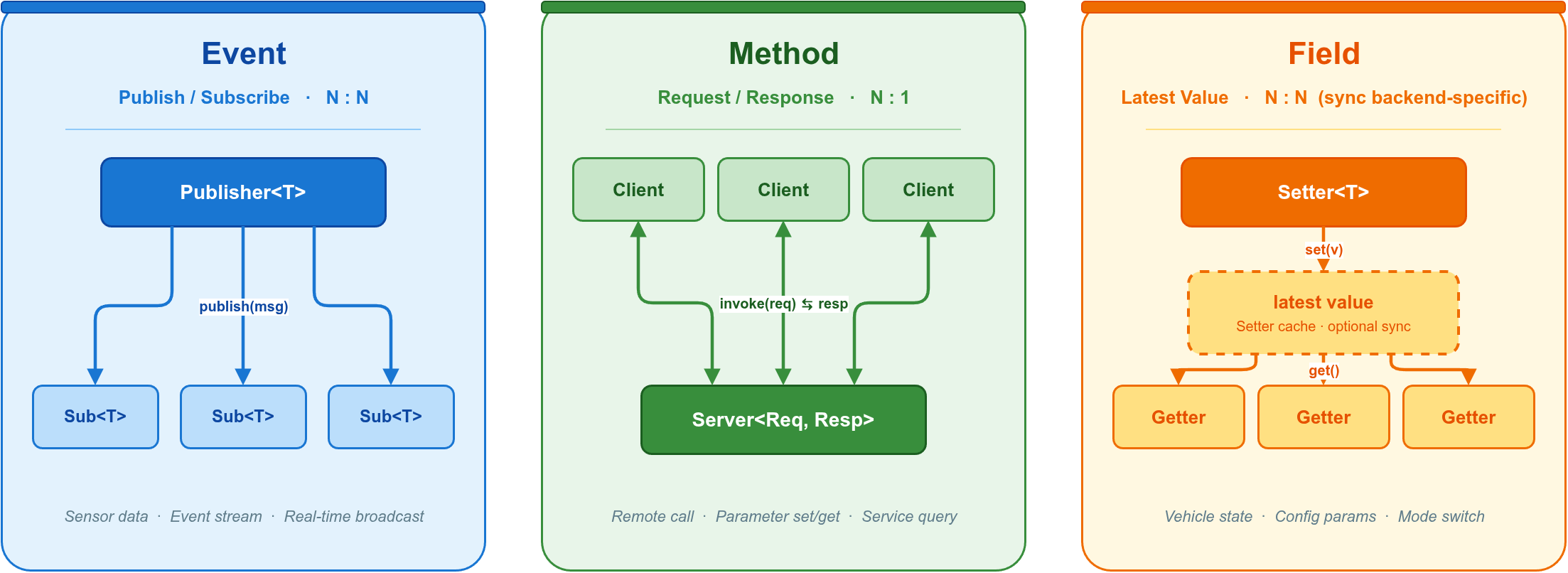
Event — publish / subscribe
Method — request / response
Field — state synchronization
| Model | Semantics | Primitives | Typical use |
|---|---|---|---|
| Event | publish/subscribe | Publisher<T> / Subscriber<T> | sensor streams, perception broadcast |
| Method | request/response | Client<Req,Resp> / Server<Req,Resp> | map queries, parameter access, services |
| Field | state sync | Setter<T> / Getter<T> | vehicle state, configuration, calibration |
| Scheme | Underlying | Scope | Zero-copy | Status |
|---|---|---|---|---|
intra:// | built-in queue | intra-process | conditional (direct shared-pointer path) | stable |
shm:// | Iceoryx | same-host | conditional (transport loan) | stable |
dds:// | Fast-DDS | cross-machine | no | stable |
ddsc:// | CycloneDDS | cross-machine | no | stable |
shm2:// | Iceoryx2 | same-host | yes | beta |
ddsr:// | RTI Connext | cross-machine | no | beta |
zenoh:// | Zenoh | cross-machine / edge | conditional | beta |
someip:// | vsomeip | automotive Ethernet | no | beta |
mqtt:// | Paho MQTT | cloud | no | beta |
fdbus:// | FDBus | same-host | no | beta |
URL syntax, query parameters, and per-backend notes are in Transport Backends and URL.
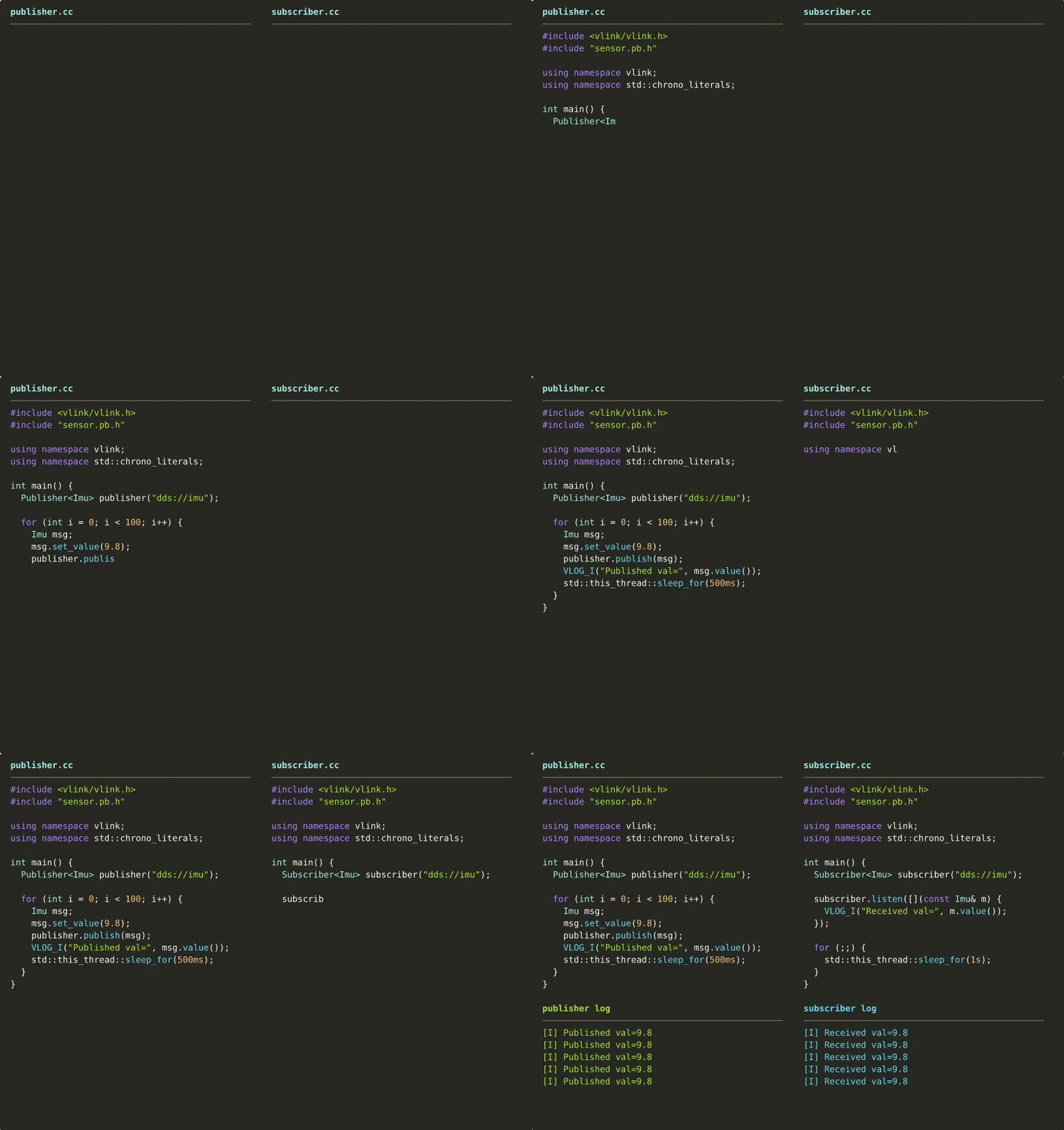
Building with VKit is recommended. VKit integrates multi-repository source fetching, cross-platform toolchain distribution, layered component orchestration, and packaging into a single pipeline that builds VLink with identical commands on Linux / QNX / Android / macOS / Windows, depending only on Bash and CMake.
VLink can also be integrated into an existing CMake project:
Full build, cross-compilation, and integration details are in Build and Integration.
VLink comprises three coordinated repositories:
| Repository | Role | URL |
|---|---|---|
| VLink | the communication middleware (this repository) | https://github.com/thun-res/vlink |
| VKit | cross-platform build and release toolkit | https://github.com/thun-res/vkit |
| VMsgs | standard message definitions for perception / planning / localization / map, etc. (Protobuf / FlatBuffers) | https://github.com/thun-res/vmsgs |
📄 VLink Whitepaper — a full academic treatment of industry background, technical argumentation, comparison, and performance analysis.
The following is a 16-part learning path, best read in order.
Introduction
| Document | Content |
|---|---|
| 0. Overview and Design Philosophy | positioning, core abstraction (URL as contract), architecture, capabilities |
| 1. Getting Started | VKit build, first program, examples guide |
Core
| Document | Content |
|---|---|
| 2. Communication Models | node base and the Event / Method / Field models |
| 3. Serialization | type-driven automatic serialization |
Transport and Capabilities
| Document | Content |
|---|---|
| 4. Transport and URL | 10 backends and URL specification |
| 5. QoS | quality-of-service policies and profiles |
| 6. Zero-Copy | loan interface and perception data containers |
| 7. Security | message-level encryption and key management |
| 8. Base Library | Logger / MessageLoop / Timer / ThreadPool, etc. |
| 9. Recording and Playback | Bag / MCAP formats and API |
Tools and Operations
| Document | Content |
|---|---|
| 10. CLI Tools | 10 command-line tools |
| 11. Visualization (Viewer / WebViz) | desktop Viewer and Foxglove / Rerun bridges |
| 12. Discovery and Proxy Monitoring | topology discovery and cross-segment observation |
Integration and Reference
| Document | Content |
|---|---|
| 13. Integration and Extension | C API, plugin system, environment variables |
| 14. Cheatsheet and Troubleshooting | single-page API/URL/QoS/CLI reference and symptom index |
| 15. Testing and Contributing | test framework and contribution workflow |
VLink automatically runs benchmarks and coverage analysis on every release and publishes the full reports.
| Report | Online report | Wiki summary |
|---|---|---|
| 🚀 Benchmarks (vlink-bench) | View online | Benchmarks |
| 🧪 Code coverage | View online | Coverage |
| Platform | Architecture | Compiler | Status |
|---|---|---|---|
| Linux | x86_64 / aarch64 | GCC 9+ / Clang 10+ | stable |
| QNX 7.x / 8.x | aarch64 / x86_64 | QCC (QNX SDP) | stable |
| Android | aarch64 / x86_64 | NDK Clang r25+ | stable |
| Windows 10+ | x86_64 | MSVC 2019+ / MinGW | stable |
| macOS 10.15+ | x86_64 / arm64 | AppleClang 12+ | beta |
VLink is maintained by Thun Lu. PRs, issues, and documentation improvements are welcome. Please read the Contributing guide before submitting.
[Apache License 2.0](LICENSE) — free for commercial use.
Copyright (C) 2026 Thun Lu. All rights reserved.
 1.9.1
1.9.1