 |
VLink
2.1.0
A high-performance communication middleware
|
|
VLink
2.1.0
A high-performance communication middleware
|
VLink 的 base 基础库是一套轻量、高性能、无第三方强制依赖的底层工具集,为通信核心与上层应用共同提供日志、调度、并发、计时、IPC 与唯一标识等能力。除 Coroutine 依赖 C++20 协程外,其余组件以 C++17 为基线,可脱离通信层独立使用,只需链接 vlink::vlink。
本章按任务定位组件,给出能力边界、高频接口与最小可运行示例;接口完整签名与语义约束以对应头文件为准。
按任务选取组件,再进入对应小节;低频与内部工具见 附录 A。
| 任务 | 组件 | 头文件 | 小节 |
|---|---|---|---|
| 日志输出 | Logger(VLOG_* 宏) | base/logger.h | 8.2 |
| 承载/传递原始字节 | Bytes | base/bytes.h | 8.3 |
| 对象与 PMR 容器复用内存池 | MemoryPool / MemoryResource | base/memory_pool.h | 8.4 |
| 类型擦除的可调用包装 | Function / MoveFunction | base/functional.h | 8.5 |
| 单线程串行调度回调(免锁) | MessageLoop | base/message_loop.h | 8.6 |
| 周期/单次/高精度计时 | Timer 等四种 | base/timer.h | 8.7 |
| 并行计算 | ThreadPool / MultiLoop | base/thread_pool.h / base/multi_loop.h | 8.8 |
| 可取消/等待/查状态的任务 | TaskHandle / Cancellation | base/task_handle.h / base/cancellation.h | 8.9 |
| 子进程启动与管理 | Process | base/process.h | 8.10 |
| 对象复用、无锁队列、互斥、限流 | ObjectPool / MpmcQueue / SpinLock / Semaphore / ConditionVariable | base/object_pool.h 等 | 8.11 |
| 跨进程同步/共享内存 | SysSemaphore / SysSharemem | base/sys_semaphore.h / base/sys_sharemem.h | 8.12 |
| 延迟/超时任务、DAG 编排 | Schedule / GraphTask | base/schedule.h / base/graph_task.h | 8.13 |
| CPU 利用率测量 | CpuProfiler | base/cpu_profiler.h | 8.14 |
| 唯一标识/随机 token | Uuid | base/uuid.h | 8.15 |
| 协程化异步流程(C++20) | Coroutine(vlink::Co) | base/coroutine.h | 8.16 |
vlink::Logger 是全局单例日志器:Logger::init() 初始化一次后,可在任意位置经宏写日志。输出同时面向控制台与文件两个 Sink,二者最低输出级别独立设置。
每条日志携带一个级别。set_console_level / set_file_level 分别控制对应 Sink 的最低输出级别,低于阈值的日志被丢弃。
| 级别 | 用途 |
|---|---|
kTrace | 详细内部跟踪 |
kDebug | 开发调试信息 |
kInfo | 低频正常状态或生命周期 |
kWarn | 异常但可恢复 |
kError | 当前操作失败但进程可继续 |
kFatal | 无法安全继续;记录后抛出 Exception::RuntimeError |
kOff | 关闭对应 Sink |
四种写法对应同一套级别短宏(_T/_D/_I/_W/_E/_F)。
| 写法 | 宏前缀 | 示例 | 特点 |
|---|---|---|---|
| 流式拼接 | VLOG_* | VLOG_I("x=", x) | 拼接式,零堆分配 |
| 占位格式化 | MLOG_* | MLOG_I("x={}", x) | {} 占位符 |
| C 风格 | CLOG_* | CLOG_I("x=%d", x) | printf 风格 |
| RAII 流 | SLOG_* | SLOG_I << "x=" << x | 析构时提交 |
新代码默认优先 VLOG_*。多段嵌入值、宽度/精度等复杂格式控制推荐 CLOG_*,格式符必须与实参类型一致;MLOG_* 主要沿用已经采用 {} 占位和 formatter 的模块。Info 不用于逐帧热路径;Fatal 只用于状态已 无法安全继续的错误,不用于普通参数校验或可恢复失败。
kFatal 级别在写日志后抛出异常,e.what() 携带日志消息,可经 try/catch 捕获。编译期级别过滤、自定义日志后端、崩溃回溯环形缓冲等进阶能力见头文件。完整示例见 examples/base/logger_basic/。
高频路径可使用 VLOG_{T,D,I,W,E}_EVERY_MS(interval_ms, ...),在同一源码调用点按周期限制重复日志:
首次满足日志级别的调用立即输出;此后同一调用点在间隔内最多输出一次。调用点状态由并发线程共享,竞争时仅一个线程获得输出资格;函数模板中的调用点由各模板特化分别持有状态。被抑制时日志参数不会求值。interval_ms <= 0 表示不限制,且不更新时间戳。
该能力仅提供给 C++ 拼接式 VLOG 的 Trace 至 Error 级别,不提供 Fatal、MLOG、CLOG 或 SLOG 变体。Python 日志函数接收已经构造完成的字符串,无法保留宏的调用点及参数惰性求值语义,因此不提供对应接口。完整宏名和底层契约见 base/logger.h。
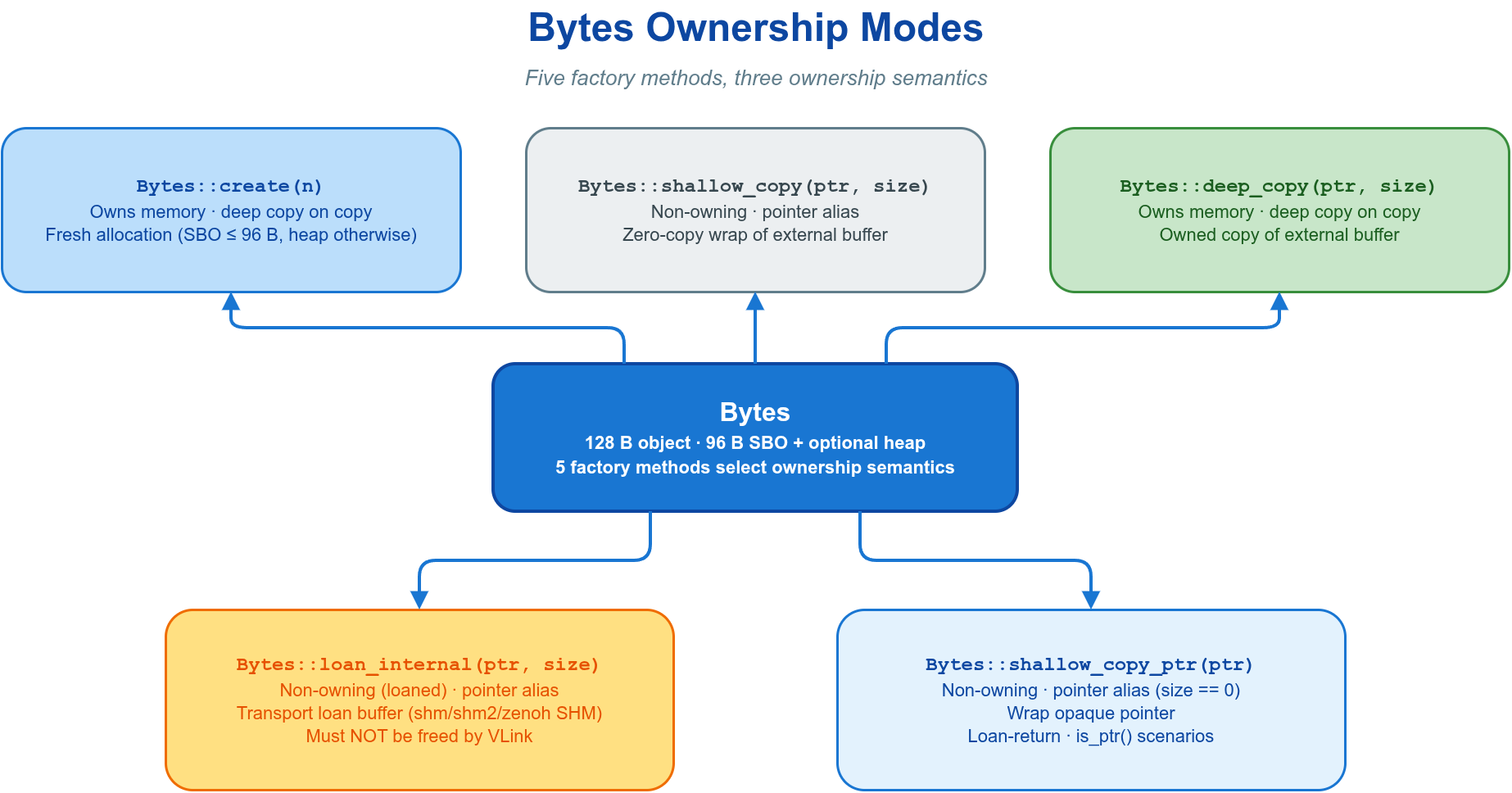
vlink::Bytes 是 VLink 的核心数据载体:小数据直接内联在对象内部,避免堆分配;超出内联容量时才从内存池取块。它既可新建并拥有数据,也可零拷贝包装外部缓冲区。Bytes 在序列化系统中的角色见 消息序列化。
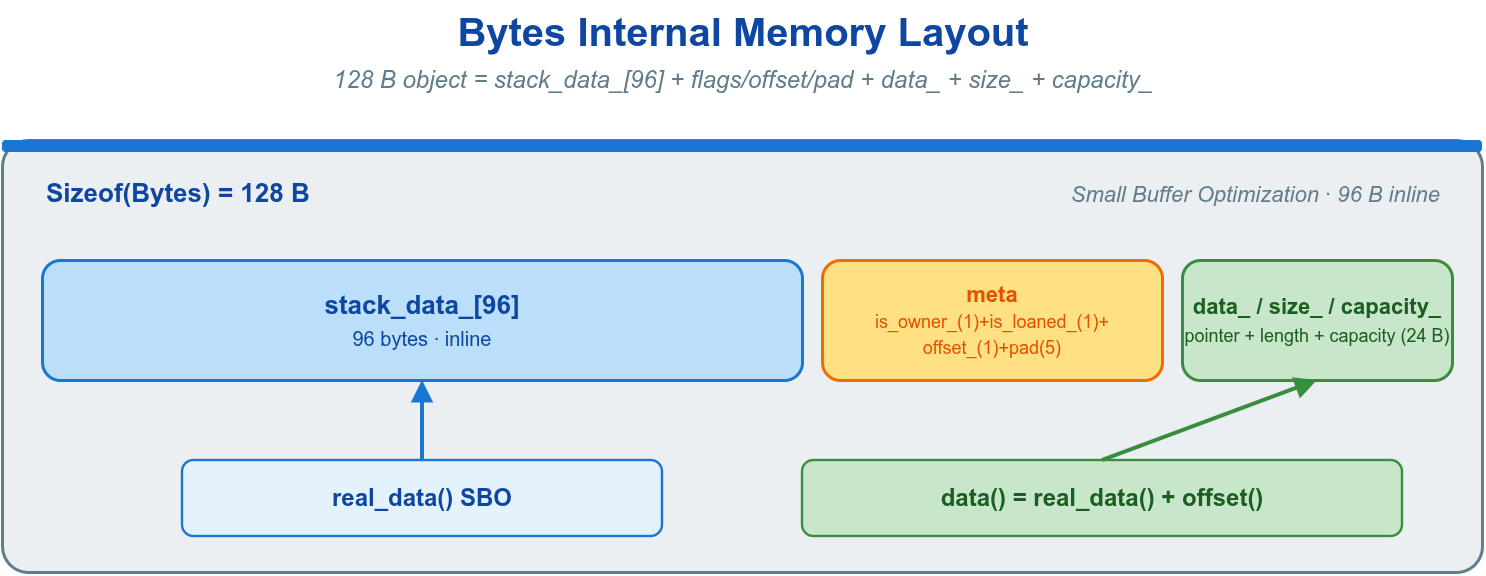
构造方式决定所有权与复制语义。Bytes 的拷贝构造和拷贝赋值都会产生拥有数据的深拷贝;性能敏感路径传递已有对象时优先移动,明确需要零拷贝别名时使用 shallow_copy,仅在需要独立持有数据的副本时才用 deep_copy。
| 构造方式 | 是否拥有数据 | 复制语义 | 用途 |
|---|---|---|---|
Bytes::create(n) | 是 | 拥有副本 | 新建并填充缓冲区 |
Bytes::shallow_copy(p, n) | 否 | 指针别名 | 零拷贝包装外部缓冲区 |
Bytes::deep_copy(p, n) | 是 | 拥有副本 | 持有外部数据的独立副本 |
| 方法 | 语义 |
|---|---|
Bytes::create(size, offset=0) | 分配缓冲区,可预留前缀字节 |
Bytes::shallow_copy(data, size) | 零拷贝包装外部缓冲区 |
Bytes::deep_copy(data, size) | 拷贝外部数据并拥有 |
| 拷贝构造 / 拷贝赋值 | 深拷贝并拥有;传递时不可视为廉价共享 |
Bytes::from_string(str) | 从字符串构造 |
data() / size() / empty() | 访问指针、长度、是否为空 |
to_string() / to_string_view() | 转字符串 / 视图 |
resize(n) / shrink_to(n) / clear() | 调整大小 / 清空 |
完整示例见 examples/base/bytes_basic/。
Bytes 静态方法提供常用数据处理,避免引入额外依赖:
Bytes::compress_data(data, size, high_ratio=false) / uncompress_data(...) / is_compress_data(...)。Bytes::encode_to_base64(buf) / decode_from_base64(str)。Bytes::get_crc_32(buf)(与 ZIP/gzip/PNG 一致)、get_crc_64(buf)。Bytes::init_memory_pool() 在应用启动时调用一次,见 8.4。vlink::MemoryPool 是 Bytes 的默认堆分配器,按尺寸分级复用空闲块以减少 new/delete 开销。常规用法是在应用启动时初始化一次,其余分配由 Bytes 自动经过该池。
VLINK_MEMORY_LEVEL(0..9,默认 3)选择;VLINK_MEMORY_PREALLOC=1 在启动时预分配。检测到重复并发争用后 free list 会自动分片,偶发单次锁冲突仍保留 primary 快路径。空分片每次跨分片转移的节点数由 MemoryPool::Config::batch_size 控制(默认 16);全局默认配置可用 VLINK_MEMORY_BATCH_SIZE 覆盖。三者含义见 环境变量。vlink::MemoryResource 让 std::pmr 容器复用同一池:MemoryResource::make_shared 将对象与控制块在池内一次性分配,make_unique 仅在池内分配对象本体;两者均回退到全局池。需要隔离的私有池时,向构造函数传入 MemoryPool::Config 或 level(MemoryResource(int level, bool prealloc=false))创建独立实例。显式 Config 的 batch_size 以字段值为准,不受环境变量覆盖。
base/functional.h 提供两个类型擦除的可调用包装器,作为热路径(消息回调、定时器、线程池任务)上 std::function 的替代:默认将一定容量内的闭包内联存储以避免堆分配,更大的闭包走内存池。承载更重闭包时使用大档别名 LargeFunction / LargeMoveFunction。
| 类型 | 拷贝语义 | 适用场景 |
|---|---|---|
vlink::Function | 可拷贝 | 需要被拷贝或共享的回调(默认选择) |
vlink::MoveFunction | move-only | 闭包捕获 unique_ptr / packaged_task 等不可拷贝对象 |
边界条件:
std::bad_function_call,与 std::function 一致。std::function 可双向隐式互转;vlink::Function 可移动转换为 vlink::MoveFunction。MoveFunction::operator() 为非 const;需要 const 调用语义时使用 Function。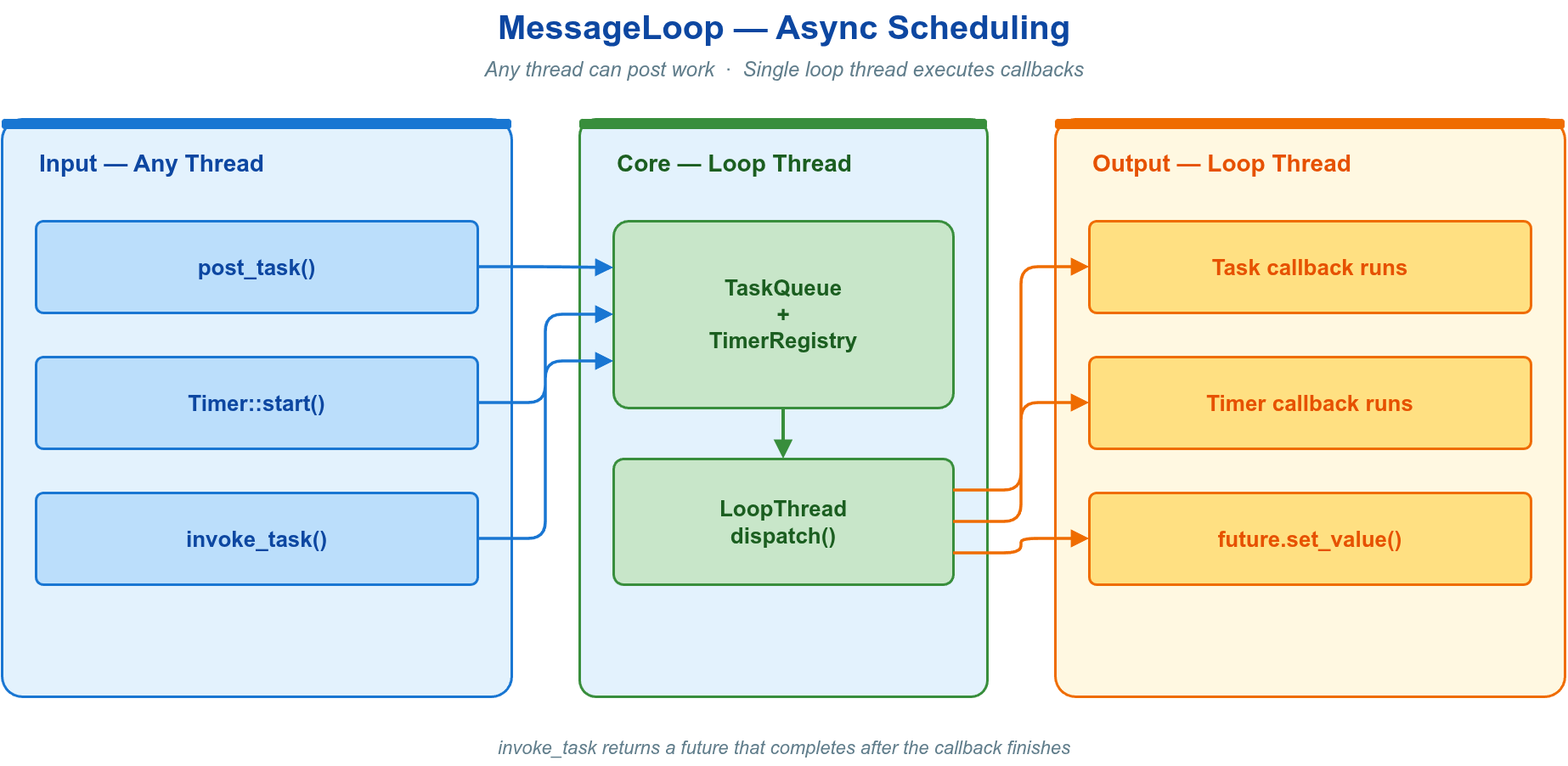
vlink::MessageLoop 是 VLink 的核心任务调度器,也是 Timer、Schedule 的执行基础。其语义是单线程串行事件循环:投递到同一 loop 的所有任务在同一线程顺序执行,因此回调内访问该 loop 的私有状态无需加锁。post_task() 自身线程安全,可从任意线程调用。
| 方法 | 语义 |
|---|---|
async_run() | 在后台线程启动循环;run() 在当前线程阻塞运行 |
post_task(cb) | 投递任务到 loop 线程(fire-and-forget) |
invoke_task(fn, args...) -> future | 投递并经 future 取返回值 |
quit(force=false) / wait_for_quit() | 请求退出 / 等待退出完成 |
is_in_same_thread() | 判断当前是否在 loop 线程,防止 invoke_task 死锁 |
完整示例见 examples/base/message_loop_basic/。
invoke_task 经 std::future 取回结果。约束:不可在 loop 自身线程上对其返回的 future 调用 .get()——任务等待被执行,线程却等待任务完成,构成死锁。用 is_in_same_thread() 防护:
Timer 绑定到 MessageLoop 后,定时回调与普通任务共用同一线程,回调间无需同步:
通信回调的执行线程随后端与模式而异;例如下列 dds:// 回调通常来自后端 delivery thread,而 intra #direct 会在调用线程同步执行。需要固定业务线程时,可把普通临时消息复制后投递到自有 MessageLoop 串行处理:
回调用法详见 通信模型。
构造时可选队列类型;入队策略仅在有界队列已满时影响行为。
| 队列类型 | 特点 |
|---|---|
kNormalType | 默认,FIFO 无优先级 |
kLockfreeType | 无锁,适合多生产者多消费者、低竞争 |
kPriorityType | 支持任务优先级(数值大者先执行) |
| 入队策略(队列满时) | 行为 |
|---|---|
kOptimizationStrategy | 默认,重试至多 10 次(每次间隔 1ms)后丢弃一个可丢弃任务再入队 |
kPopStrategy | 立即丢弃一个可丢弃任务并入队新任务 |
kBlockStrategy | 持续重试直至有空闲槽位 |
优先级循环用 post_task_with_priority(cb, priority),priority 为必填参数(无默认值),取值自 kLowestPriority 至 kHighestPriority,常规任务约定使用优先级常量 kNormalPriority;其他队列类型忽略优先级。QoS 扩展中的 Qos::Additions::Priority 是独立于 MessageLoop 优先级的另一套配置,见 QoS 配置。
exec_task() 在 post_task() 基础上支持延迟、超时与链式延续回调,参数为 Schedule::Config(见 8.13):
任务延迟到句柄提交时投递(临时句柄在表达式结束析构即提交),保证延续回调先于任务执行注册;存入具名变量的句柄须调用 dispatch() 立即投递。
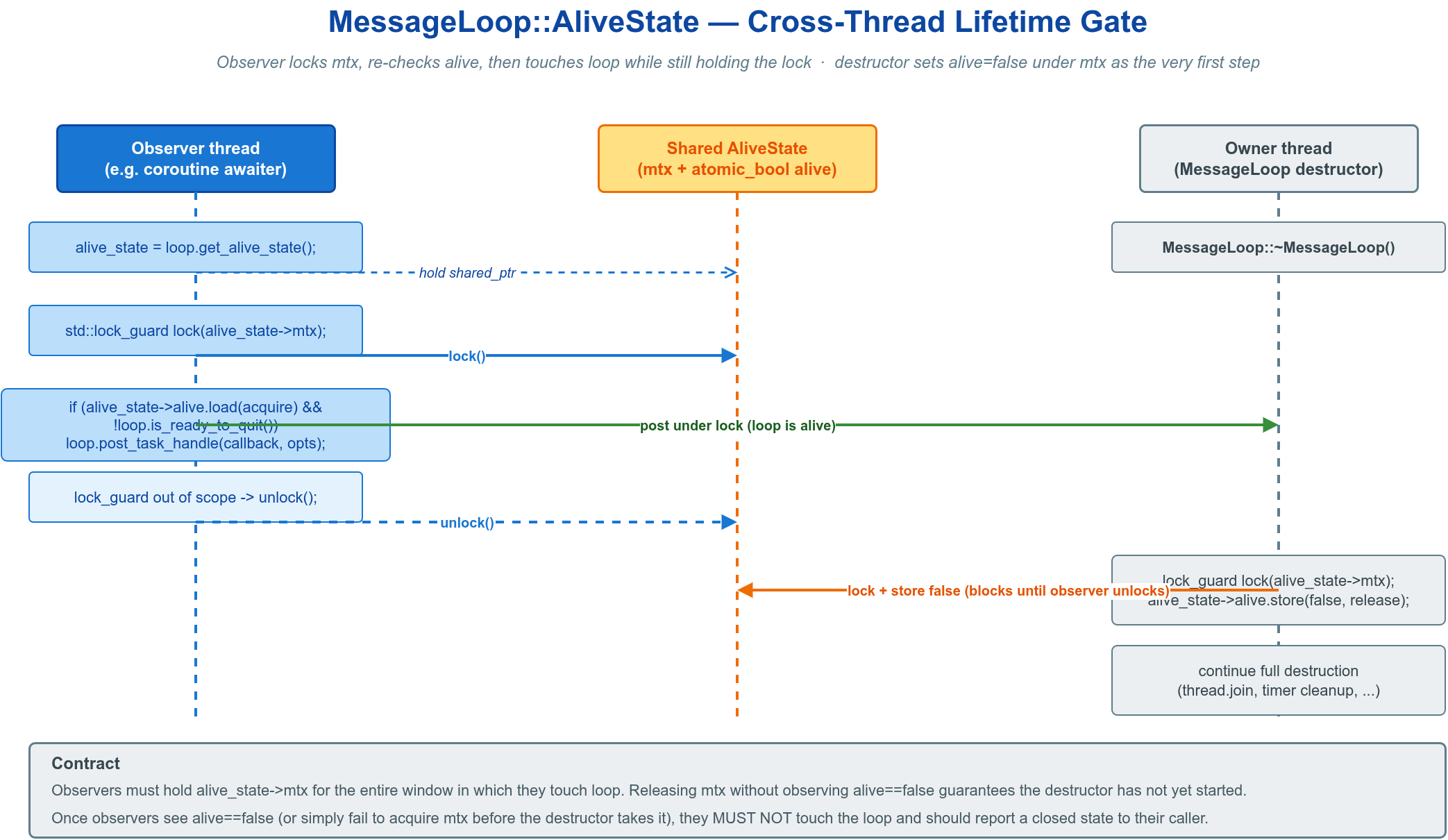
| 操作 | 线程安全 | 约束 |
|---|---|---|
post_task / quit | 是 | 可从任意线程并发调用 |
invoke_task | 是 | 不可在同一 loop 线程上对返回 future 调 .get() |
run / async_run | 启动互斥 | run() 在调用线程执行,async_run() 新建后台线程;已运行时再次启动返回 false |
| 多 loop 线程访问同一状态 | 否 | 需额外同步(mutex / 原子量) |
常见陷阱:
is_in_same_thread() 防护。post_task 新任务,但不可在任务内 wait_for_idle() 等待自身。ThreadPool,结果再 post_task 回来(见 8.8)。post_task() 为 fire-and-forget。需要取消、等待或查询状态时使用 post_task_handle(),返回 TaskHandle,见 8.9。
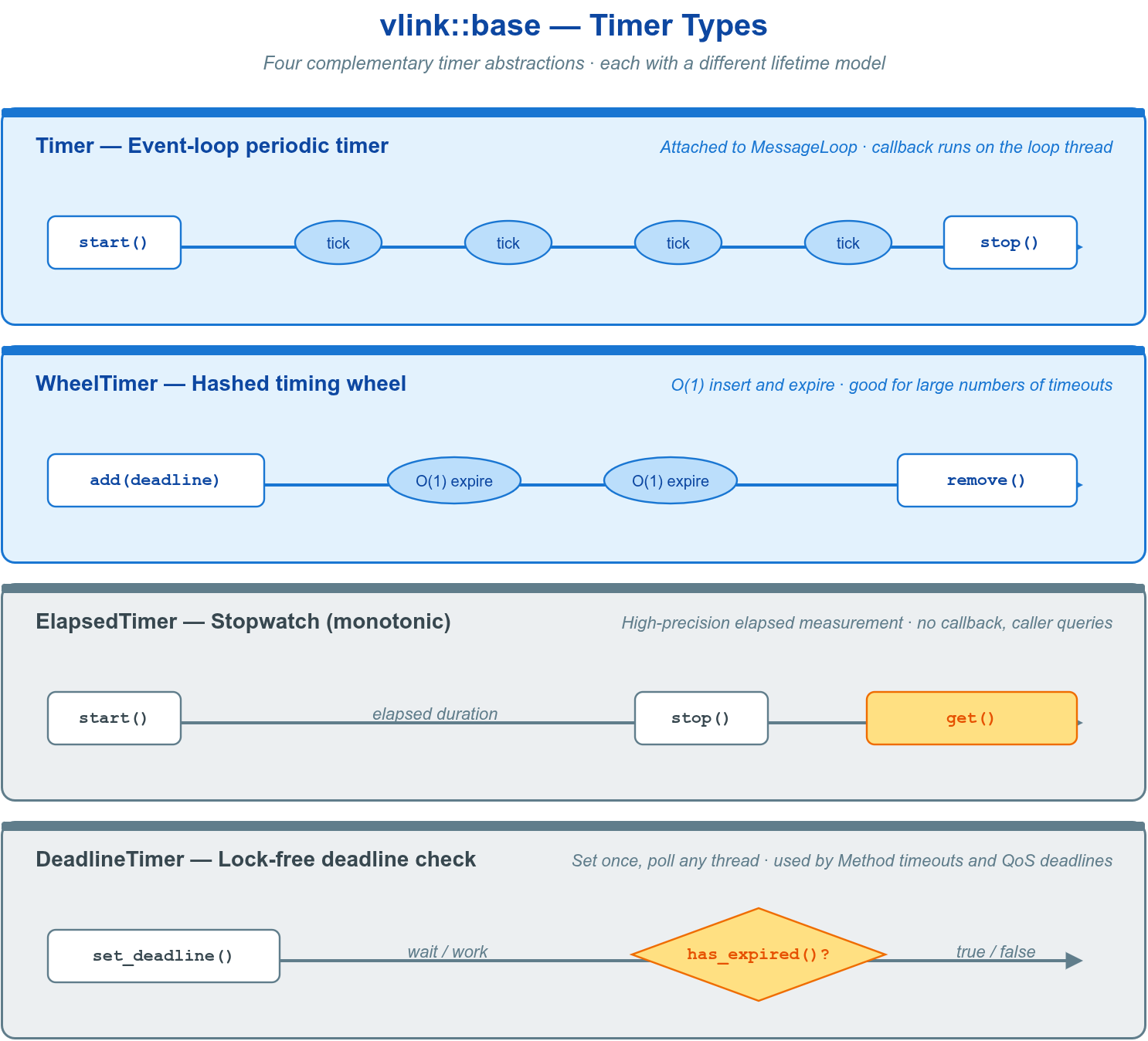
VLink 提供四种定时器,Timer 用于事件循环驱动的通用定时,其余三种针对特定场景。
vlink::Timer 绑定到 MessageLoop,回调在循环线程上串行触发,无需同步。
| 方法 | 语义 |
|---|---|
start() / stop() / restart() | 启动 / 停止 / 重置后重启 |
set_interval(ms) / set_loop_count(n) | 修改间隔 / 触发次数,对活跃定时器立即生效 |
set_strict(true) | 严格模式:错过的 tick 立即补发 |
is_active() / get_invoke_count() | 是否运行 / 已触发次数 |
Timer::call_once(loop, ms, cb) | 静态方法,单次触发 |
kInfinite(-1) 表示无限重复。interval_ms 为 0 时被钳至最小保护间隔,避免空转。完整示例见 examples/base/timer/。
WheelTimer**(base/wheel_timer.h):哈希时间轮,插入/删除均摊 O(1),适合数十万级并发超时(连接保活、会话超时)。回调在内部工作线程触发,通常投递回 MessageLoop 处理。ElapsedTimer**(base/elapsed_timer.h):高精度计时,实例支持单调时钟与 CPU 活跃时间,毫秒/微秒/纳秒精度(系统墙钟仅由静态 get_sys_timestamp() 提供)。DeadlineTimer**(base/deadline_timer.h):保存绝对到期时间戳,has_expired() / remaining_time() 无锁,可多线程并发读。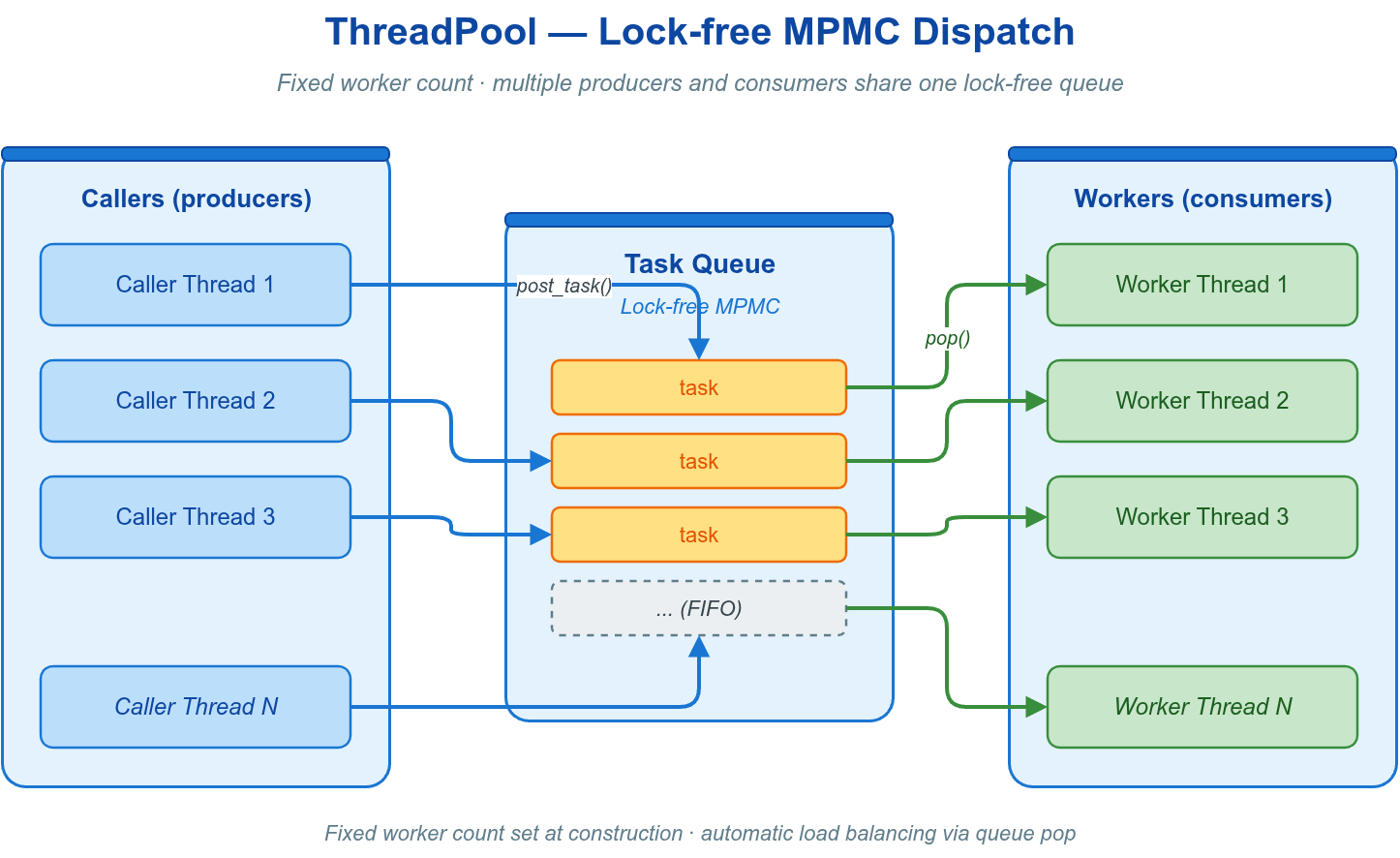
并行执行任务时使用 ThreadPool(纯计算并行)或 MultiLoop(兼需定时器与并行)。
vlink::ThreadPool 维护固定数量工作线程并行执行任务,不含定时器,适合 CPU 密集型工作。
| 方法 | 语义 |
|---|---|
ThreadPool(n) | 构造,指定线程数 |
post_task(cb) | 投递任务 |
invoke_task(fn, args...) -> future | 投递并取结果 |
shutdown() | 关闭 |
is_in_work_thread() | 判断是否在工作线程,防死锁 |
与 MessageLoop 同理:不可在线程池工作线程内对 invoke_task 的 future 调 .get(),否则死锁;用 is_in_work_thread() 防护或改用 post_task()。post_task_handle() 返回 TaskHandle,语义与 MessageLoop 一致(见 8.9)。
典型模式是 CPU 密集任务下发到 ThreadPool,结果投递回 MessageLoop 串行更新:
vlink::MultiLoop 继承 MessageLoop,保持相同的 post_task / invoke_task / exec_task 接口,但任务被转发到内部线程池并行执行,适合既需定时器又需多线程吞吐的场景(如传感器流水线)。
SpinLock / mutex)。ThreadPool,不在任务回调内对 invoke_task 的 future 同步等待,否则可能因线程池耗尽死锁。| 特性 | MessageLoop | ThreadPool | MultiLoop |
|---|---|---|---|
| 执行模型 | 单线程串行 | 固定线程池并行 | 事件循环 + 线程池并行 |
| 任务顺序 | kNormalType 为 FIFO;kPriorityType 按优先级、同优先级按序 | 无保证 | 无保证 |
| 定时器 | 支持 | 不支持 | 支持(继承) |
| 适用场景 | 有序任务派发 | 纯计算并行 | 兼需定时器与并行 |
post_task() 为 fire-and-forget。需要取消、等待或查询状态时使用可追踪变体 post_task_handle(),返回 TaskHandle;配合 CancellationSource 可成组取消。
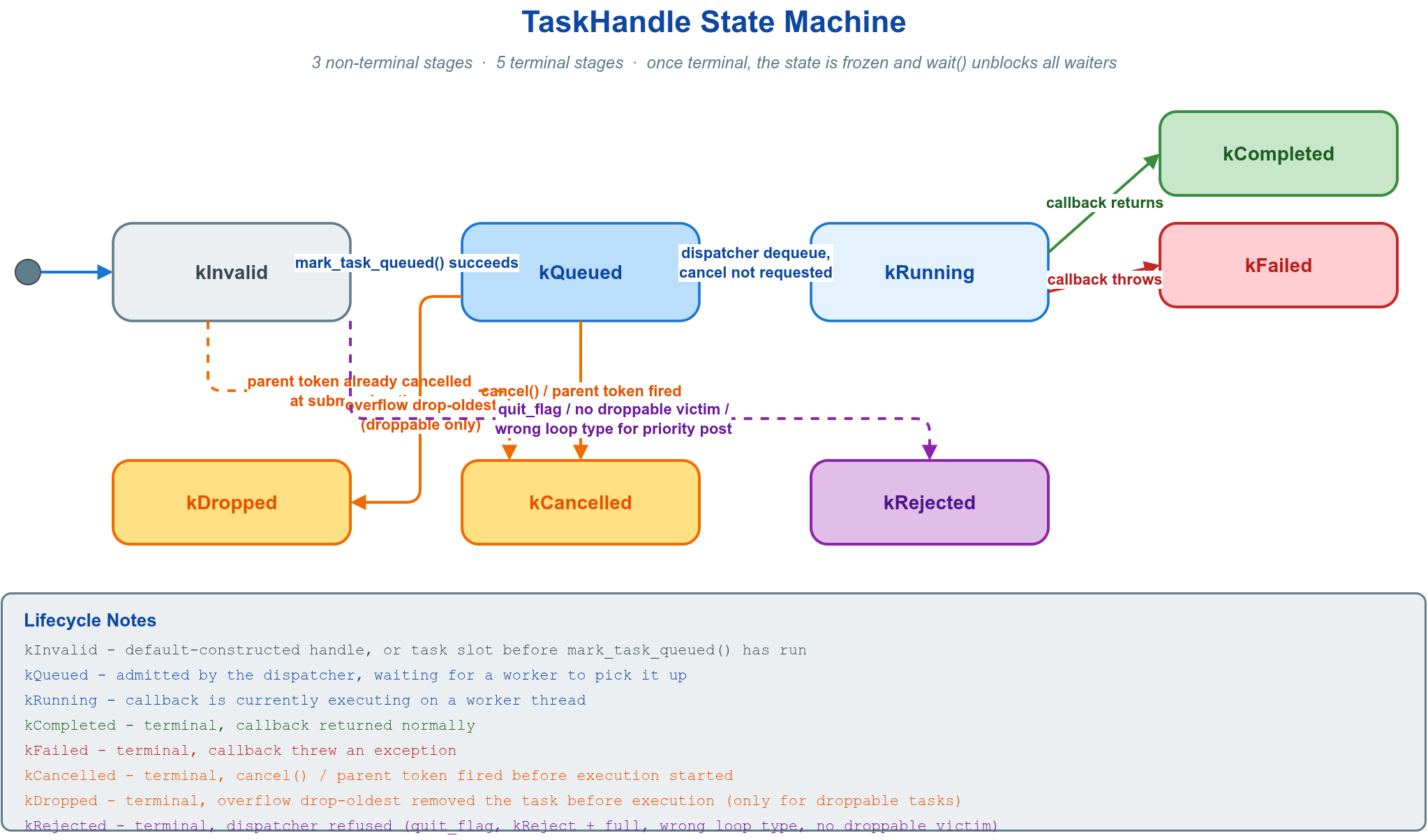
TaskExecutionState 转移:kQueued → kRunning → 终态之一(kCompleted 正常返回 / kCancelled 被取消 / kDropped 溢出丢弃 / kRejected 拒收 / kFailed 抛异常)。
PostTaskOptions 字段:
| 字段 | 取值 |
|---|---|
overflow_policy | kUseDispatcherStrategy(默认) / kReject / kBlock |
drop_policy | kDroppable(默认) / kProtected(永不被溢出丢弃) |
cancellation_token | 父级取消 token |
边界条件:句柄析构不会取消任务,dispatcher 持续执行至终态。kLockfreeType 队列不追踪 kProtected,要保护任务不被溢出丢弃须使用 kNormalType / kPriorityType。
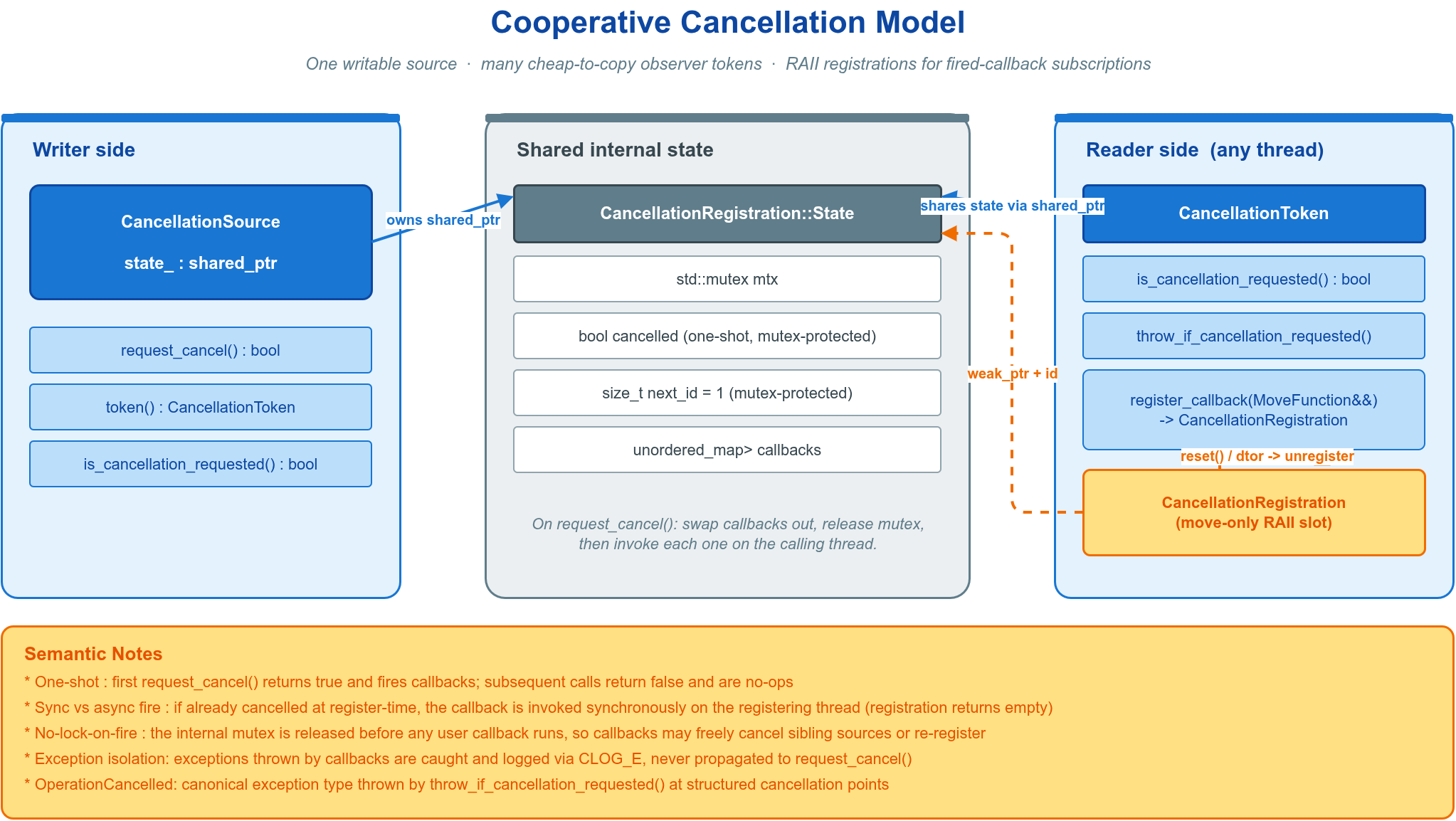
协作取消基于写端/观察者模型:写端持 CancellationSource 调用 request_cancel();工作任务持由同一 source 派生的 CancellationToken(轻量、可拷贝、可跨线程),经轮询或回调响应取消。
| 类型 | 角色 |
|---|---|
CancellationSource | 写端,发出取消请求(副本共享同一状态) |
CancellationToken | 只读观察者,可轮询、可注册回调 |
CancellationRegistration | RAII 槽,持有一个已注册回调 |
Exception::OperationCancelled | 协作取消的规范化异常类型 |
成组取消(一个 source 派生多个 token):
语义约束:
request_cancel() 一次性触发:首次返回 true 并触发全部回调,后续返回 false。register_callback 内同步执行。Exception::OperationCancelled(what() 固定为 "vlink operation cancelled")专表协作取消已被观察,通用错误应使用 Exception::RuntimeError。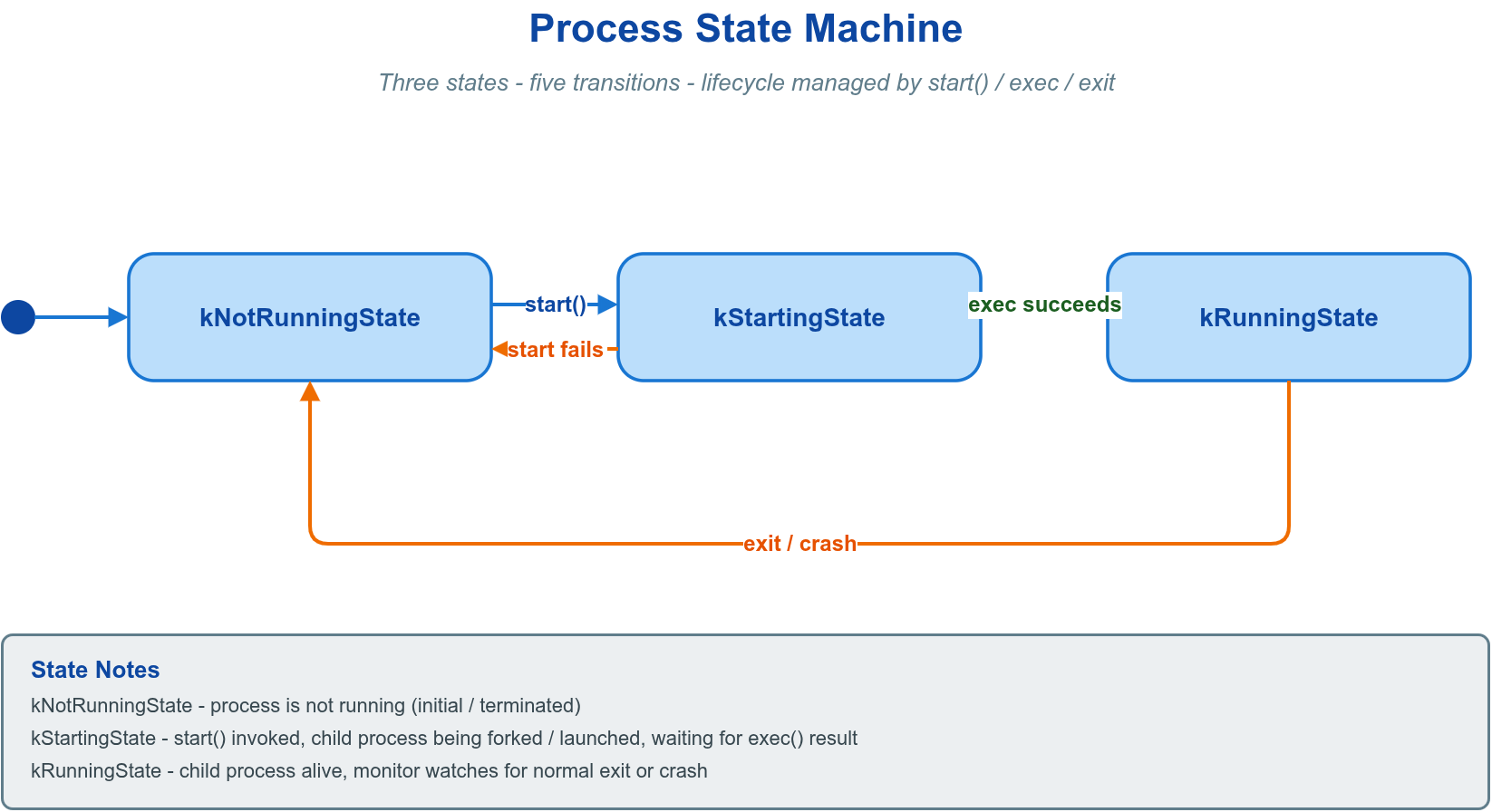
vlink::Process 是跨平台子进程管理类,接口风格参照 Qt QProcess,用于启动、监控、通信与终止外部程序,支持 stdout/stderr 管道捕获、stdin 写入与异步回调,覆盖 Linux、macOS、Windows、QNX。
| 方法 | 语义 |
|---|---|
start(program, args) | 异步启动子进程 |
start_command(cmdline) | 用完整命令行字符串启动 |
wait_for_started/finished/ready_read(ms) | 阻塞等待(默认 3000ms,kInfinite 为无限) |
read_all_output(str) / read_all_error(str) | 读取全部 stdout / stderr |
read_line_stdout(line) / can_read_line_stdout() | 按行读取 stdout |
write(str) / close_write_channel() | 写入 stdin / 关闭写通道 |
terminate() / kill() / close(force) | 优雅终止 / 强制结束 / 关闭 |
get_state() / is_running() / get_exit_code() | 状态查询 |
register_finished_callback(cb) 等 | 注册异步回调(建议在 start() 前完成以避免竞态) |
Process::execute(prog, args, ms) | 静态:同步执行并返回退出码 |
Process::start_detached(prog, args) | 静态:启动完全分离的子进程 |
I/O 通道模式(set_process_mode)共五种:默认 kSeparateMode(stdout/stderr 各自缓冲)、kMergedMode(stderr 并入 stdout 管道)、kForwardedMode(stdout/stderr 均继承父进程,不捕获)、kForwardedOutputMode(stdout 继承父进程、stderr 捕获)、kForwardedErrorMode(stdout 捕获、stderr 继承父进程)。回调在内部监控线程触发,访问共享数据须注意线程安全。Process 不可拷贝、不可移动。
需要在多线程间互斥、传输数据、复用对象或计数通知时,从下表选取。
| 组件 | 场景 |
|---|---|
ObjectPool | 复用对象、减少热路径堆分配 |
MpmcQueue | 固定容量、无锁、高吞吐的线程间数据传输 |
SpinLock | 极短临界区(纳秒级)互斥 |
Semaphore | 进程内计数信号量、限流 |
ConditionVariable | 条件等待(单调时钟,规避时钟跳变) |
ObjectPool<T> 线程安全地回收并重用对象,减少堆分配。必须经 std::make_shared 创建,因内部归还逻辑依赖指向池本身的 weak_ptr。
| 获取方式 | 返回 | 自动归还 | 场景 |
|---|---|---|---|
get() | unique_ptr<T, PoolDeleter> | 是 | 单一所有权(默认) |
get_shared() | shared_ptr<T> | 是 | 共享所有权 |
borrow() | T*(裸指针) | 否 | 手动控制归还时机 |
边界条件:池耗尽(全部对象借出且达到 max_size)时 get() 抛 std::runtime_error,应设置合理上限并准备降级路径,经 pool->stats() 监控。Policy 控制获取/归还时是否调用重置回调(kPolicyNone / kPolicyRelease(默认) / kPolicyAcquire / kPolicyBoth)。
MpmcQueue<T> 是固定容量、无锁、缓存行对齐的多生产者多消费者环形队列。
容量须不小于 1(否则构造抛 std::invalid_argument),经验值取预期突发峰值的 2 至 4 倍。默认的 push / pop 以自旋方式阻塞;需要条件变量唤醒式的阻塞收发时,按 kConditionBehavior 行为调用(push<vlink::MpmcQueue<int>::kConditionBehavior>(...) 配合 wait_not_empty() / wait_not_full()),否则 cv 通知是纯开销。
SpinLock 适用于极短临界区(数条指令,如更新关联变量或计数器),此时 std::mutex 的上下文切换开销大于等待本身。临界区含 I/O 或耗时不确定时不应使用。
| 指标 | SpinLock | std::mutex |
|---|---|---|
| 等待方式 | 用户态自旋 | 内核态阻塞 |
| 适合时长 | 极短(纳秒至微秒) | 任意 |
| 上下文切换 | 无 | 有 |
| 递归 | 死锁 | 可用 recursive_mutex |
进程内计数信号量,采用 P/V(acquire/release)语义,内部使用单调时钟以规避系统时钟跳变。
| 方法 | 语义 |
|---|---|
Semaphore(n) | 构造,初始计数 n |
acquire(n, ms) | 获取 n 个许可,最多等待 ms 毫秒(kInfinite 无限) |
release(n) | 释放 n 个许可 |
reset(true) | 恢复初始计数并中断所有等待者(acquire 返回 false) |
release() 内部获取 mutex,非 async-signal-safe,不可在信号处理函数中调用。跨进程同步使用 SysSemaphore(见 8.12)。
vlink::ConditionVariable 是 std::condition_variable 的就地替换,内部锁定 CLOCK_MONOTONIC,避免系统时钟被调整时 wait_for/wait_until 提前唤醒或永久等待。接口与标准库一致(wait / wait_for / wait_until / notify_one / notify_all),非 POSIX 平台直接别名到标准库版本。
配合 SpinLock 等非 std::mutex 锁时使用 ConditionVariableAny。
自定义并发数据结构时,将不同线程频繁写入的原子变量按缓存行对齐分布,规避伪共享。
base 层提供两个直接封装操作系统 IPC 的类,用于跨进程同步与数据共享,不依赖任何第三方库。
| 类 | 头文件 | 功能 |
|---|---|---|
SysSemaphore | base/sys_semaphore.h | 命名计数信号量 |
SysSharemem | base/sys_sharemem.h | 命名共享内存区域 |
命名的跨进程计数信号量,多个进程以相同名称访问同一内核对象。
POSIX 上名称须以 / 开头(如 /vlink_ready)。timeout_ms=0 为非阻塞尝试。析构默认 detach(false),仅关闭句柄而不删除内核对象。
命名共享内存:create() 分配并映射新区域,attach() 仅映射已存在的区域,实现零拷贝数据共享。
kReadOnly 映射上写入未定义(data() 在只读模式返回 nullptr)。共享内存本身不带同步语义,须配合 SysSemaphore 使用。受支持的 POSIX/Windows 后端会对 create() 新建区域零初始化。
这是最底层的 OS IPC 原语。需要完整的发布/订阅与零拷贝传输时,直接使用 VLink 的 shm:// 传输后端(见 传输后端与 URL),其内部即建立在此类原语之上。POSIX 命名对象在进程崩溃后不会自动删除,启动时应检查并清理残留。
vlink::Schedule 不单独构造,而经 MessageLoop::exec_task() 使用:将回调包入 Config,支持延迟、优先级、调度超时与执行超时,并返回 RAII 句柄链式注册延续回调。任务在句柄提交时才投递(临时句柄在表达式结束析构即提交,或显式调用 dispatch()),从而保证所有延续回调先于任务执行注册完成;存入具名变量的句柄须调用 dispatch() 立即投递。
Config 字段 | 含义 |
|---|---|
delay_ms | 任务发布前的延迟 |
priority | 调度优先级(kPriorityType 循环) |
schedule_timeout_ms | 未在此时间内启动则触发超时 |
execution_timeout_ms | 执行超过此时间则触发超时 |
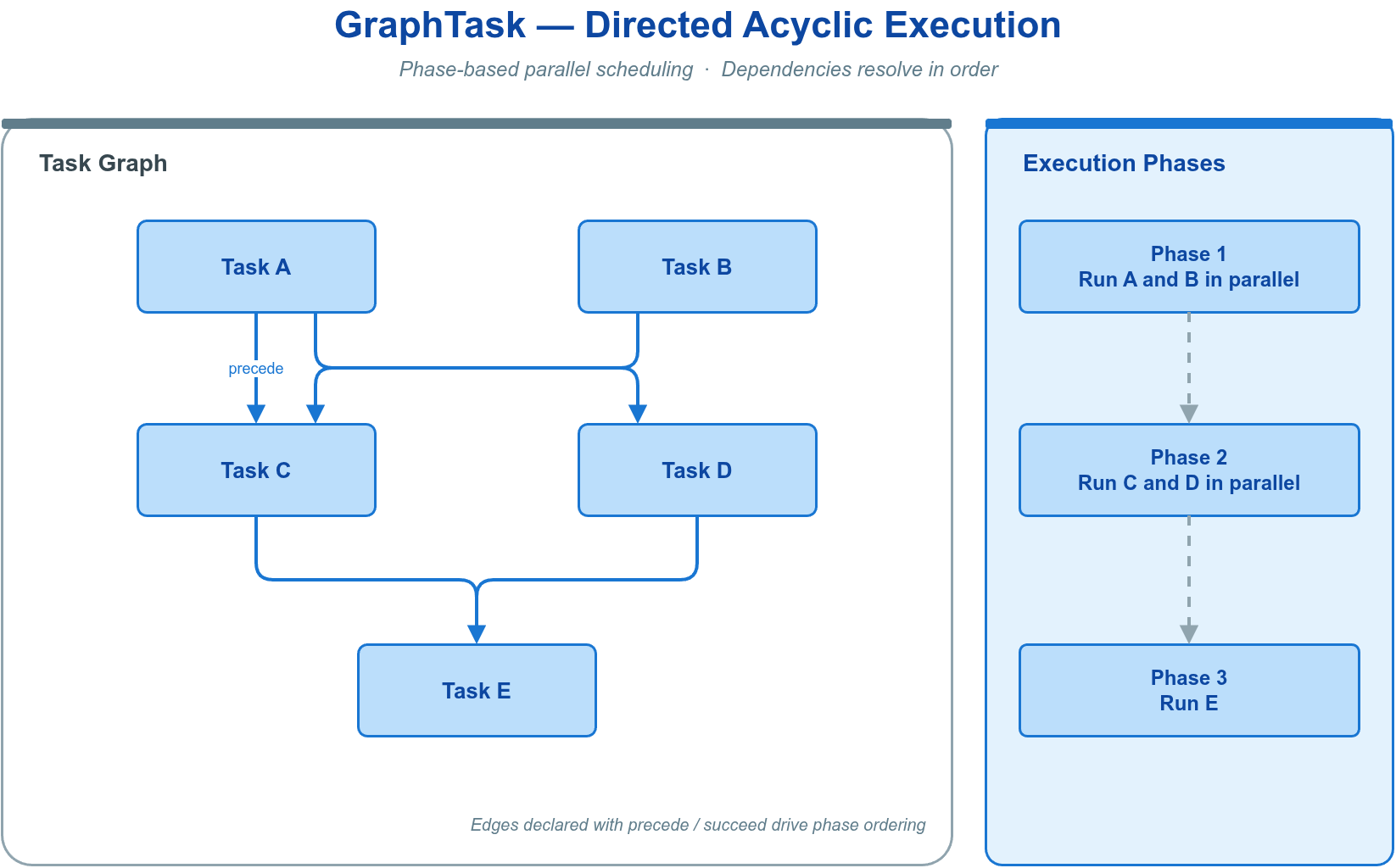
vlink::GraphTask 实现 DAG 任务调度:每个节点经 precede() / succeed() 声明依赖,再 execute() 提交到任意兼容引擎(MessageLoop / MultiLoop / ThreadPool)。
| 工厂方法 | 回调签名 | 用途 |
|---|---|---|
create(name, cb) | void() | 普通工作任务 |
create_condition(name, cb, n) | int() | 条件分支(返回值选择分支) |
依赖声明:A -- > B 等价 A->precede(B)(A 先执行、B 后执行);A -- < B 等价 A->succeed(B)。添加边前进行环路预检,成环则拒绝并记日志。
执行必须从根节点(无前驱)发起。执行策略:kPolicyOnce(默认,每次 execute 最多执行一次)、kPolicyMultiple、kPolicyWaitAll(等待所有前驱完成)。
vlink::CpuProfiler 测量一段代码的 CPU 活跃时间占总墙钟时间的百分比,用于量化节点与操作的 CPU 利用率。
get() 返回百分比(0.0 表示尚无数据;多核下若 begin/end 区间累计活跃时间超过墙钟时间,可能超过 100),restart() 取值后清零。CpuProfilerGuard 在构造时 begin、析构时 end,异常安全。
与通信节点集成:所有节点内部持有可选的 CpuProfiler,开启全局开关后自动采集,经 Node::get_cpu_usage() 取值,-1.0 表示未启用。
全局开关由环境变量 VLINK_PROFILER_ENABLE=1 控制(首次读取后缓存,见 环境变量)。节点集成细节见 通信模型。热路径可先判 CpuProfiler::is_global_enabled() 再决定是否构造 Guard。
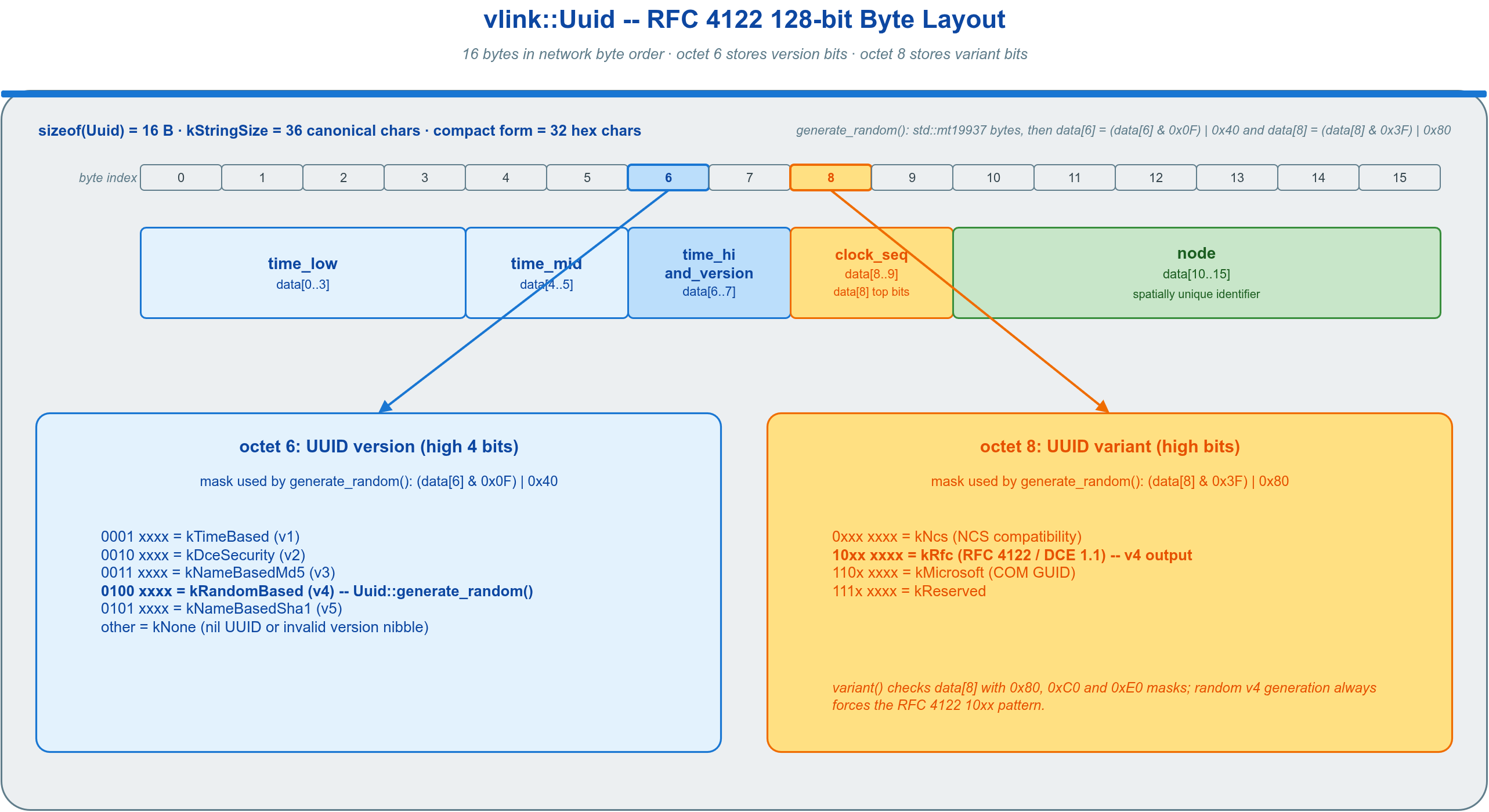
vlink::Uuid 是 RFC 4122 128 位唯一标识符值类型:可平凡复制、负载内联,提供 v4 随机生成及项目级随机字节/十六进制工具。
| 方法 | 语义 |
|---|---|
Uuid::generate_random() | 生成 v4 随机 UUID |
id.to_string() / to_compact_string() | 转规范 / 紧凑字符串 |
Uuid::from_string(s) | 解析(接受规范/紧凑/带花括号形式),返回 optional |
Uuid::is_valid(s) | 校验字符串 |
Uuid::random_bytes(n) | 生成 n 字节随机数据 |
Uuid::random_hex(n) | 生成随机十六进制串 |
边界条件:from_string / is_valid 的 const char* 重载为 null-safe(传 nullptr 返回失败)。可注入 std::mt19937 引擎获得确定性结果,也可作为 std::unordered_set 的键。底层 std::mt19937 不是密码学安全随机源,random_hex / random_bytes 适用于短期会话标识、关联 ID 与 proxy auth-token,不适用于长期密钥——后者应使用 OpenSSL RAND_bytes 等 CSPRNG。完整签名见头文件 base/uuid.h。
vlink::Coroutine(别名 vlink::Co)基于 C++20 stackless 协程。成功路径上的 schedule / yield / delay_ms / await_future / await_graph 会把恢复投递回目标 MessageLoop;若 loop 已关闭或恢复投递重试耗尽,失败恢复会在进程级 FutureWaitLoop helper thread 上执行,并由 await_resume() 抛出异常。因此正常业务段可依赖目标 loop 的串行性,但异常处理、析构清理若访问跨线程共享状态仍须同步。头文件 <vlink/base/coroutine.h>;构建需 ENABLE_CXX_STD_20=ON 且工具链同时声明 __cpp_impl_coroutine 与 __cpp_lib_coroutine(GCC 10+ / Clang 14+ / MSVC 19.x+),满足后框架自动启用协程支持。
co_await awaiter 为唯一挂起点;co_return value 设置返回值并结束。Task<T>(亦写作 Task<> 表示 Task<void>)是协程返回句柄,可 co_await、可移动、不可拷贝。co_spawn(如 co_spawn(loop, []()->Task<>{...}())),lambda 在整表达式结束即析构,捕获引用会悬空。| Awaiter | 语义 |
|---|---|
vlink::Co::schedule(loop) | 切到指定 loop 线程继续执行 |
vlink::Co::yield(loop) | 协作让出(等价同 loop 的 schedule) |
vlink::Co::delay_ms(loop, ms) | 非阻塞睡眠 ms 毫秒 |
vlink::Co::await_future(loop, fut) | 等待 std::future<T>,不在 loop 线程阻塞 .get() |
vlink::Co::await_graph(loop, graph) | 等待 GraphTask DAG 全部完成 |
协程内异常沿 co_await 链向外传播,co_spawn 在顶层捕获并记日志。MessageLoop 析构时挂起的协程进入失败分支而非崩溃。
下列组件多为内部或低频使用,需要时查阅头文件,本章不展开。
| 组件 | 头文件 | 功能 |
|---|---|---|
Format | base/format.h | 轻量 {} 占位符格式化器(MLOG_* 内部使用) |
FastStream | base/fast_stream.h | 高性能输出流(Logger 内部引擎) |
TerminalStream | base/terminal_stream.h | CLI 使用的线程安全、TTY 感知带缓冲 stdout 单例 |
Utils | base/utils.h | 进程/线程/网络/信号等跨平台工具函数 |
Helpers | base/helpers.h | 字符串/数字/哈希/转义等无状态工具 |
Quantize | base/quantize.h | 线性量化/反量化(紧凑容器复用) |
Uint128 | base/uint128.h | 可移植 128 位无符号整数 |
CachedTimestamp | base/cached_timestamp.h | 低开销线程安全格式化时间戳(Logger 内部使用) |
Plugin | base/plugin.h | 类型安全的动态插件加载器 |
Exception | base/exception.h | VLink 异常类型 |
LoggerPluginInterface | base/logger_plugin_interface.h | 自定义日志后端纯虚接口 |
Utils 中较常用的函数:
shm:// 等传输后端(建立在 IPC 原语之上)VLINK_MEMORY_* / VLINK_PROFILER_ENABLE 等环境变量examples/base/)  1.9.1
1.9.1